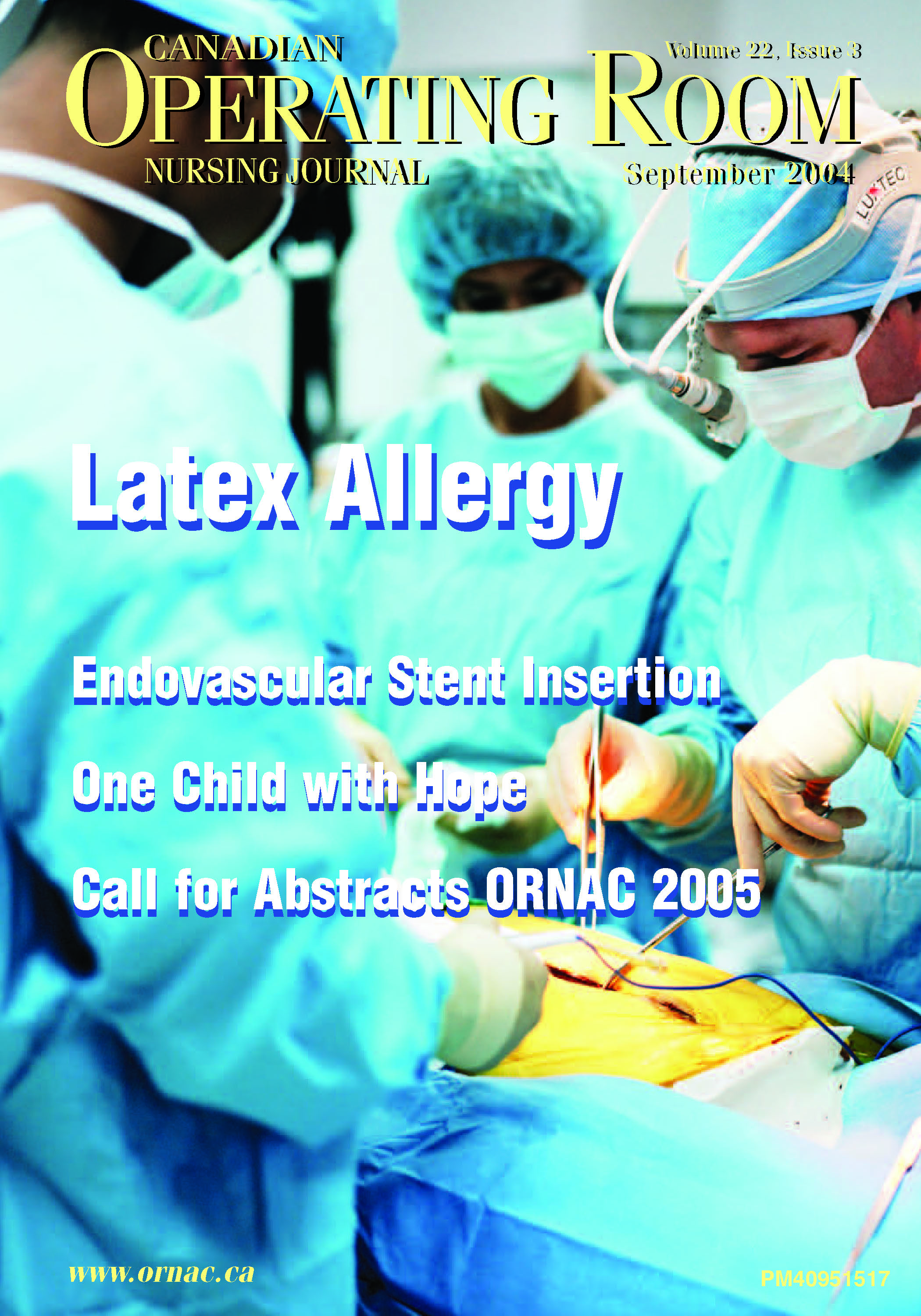
ALLERGIE AU LATEX : ENCORE UN DÉFI?
Résumé
Bien que l’utilisation des produits en latex date d’au-delà d’un siècle, les réactions allergiques aux protéines du latex ne sont reconnues en tant que grave problème de santé que depuis les 15 dernières années.1 En 1987, quand l’Occupational Health and Safety Admin- istration (OSHA) a instauré ses précautions universelles, le besoin des gants d’examen a vu une augmentation importante. Parce que tout le monde qui venait en contact avec le sang ou d’autres liquides organiques était maintenant obligé de se protéger les mains, le nombre de paires de gants utilisées par année, moins d’un milliard en 1987, a atteint 20 milliards de paires par année en 1996.2 La sensibilisation au latex est le résultat de l’exposition aux protéines du latex au fil du temps et, même si les taux de sensibilisation documentés varient, il est estimé que 8 à 12 % des travailleurs de la santé ont une sensibilisation au latex.
Références
Meade, B. J., Weissman, D. N., & Beezhold, D. H. (2002). Latex allergy past and present. InternationalImmunopharmacology. 2, 225 – 238.
Ibid.
U.S. Department of Labor, Occupational Safety and Health Administration. (2002, November) Safety and health topics: latex allergy [Electronic version]. Retrieved November 20, 2002 from http://www.osha.gov.
Toraason, M., Sussman, G., Biagini, R., Meade, J., Beezhold, D., & Germolec, D. (2000, November). Latex allergy in the workplace [Electronic version abstract]. Toxicology Science. 58 (1), 5 – 14.
National Institute for Occupational Safety and Health. (1997). Preventing allergic reactions to natural rubber latex in the workplace.
Ibid.
Association of periOperative Registered Nurses. (2004). AORN latex guidelines. AORN Standards, Recommended Practices, and Guidelines, 103-118.
Young, M. A. (1998, March). Strategies for a latex-safe environment. Surgical Services Management. 4 (3), 19 – 24.
Association of periOperative Registered Nurses. (2004). AORN latex guidelines. AORN Standards, Recommended Practices, and Guidelines, 103-118.
Ibid.
Meade, B. J., Weissman, D. N., & Beezhold, D. H. (2002). Latex allergy past and present. International Immunopharmacology. 2, 225 – 238.
American Society of Anesthesiologists. (1999). Natural rubber latex allergy: Considerations for anesthesiologists.
Kelly, K.J. (2000), Latex allergy: where do we go from here? Canadian Journal of Allergy & Clinical Immunology. 5 (8), 337 – 340.
Ellis, H. (1990, December). The hazards of surgical glove dusting powders. Surgery, Gynecology & Obstetrics. 171, 521 – 527.
Ibid. 16. Ibid 17. Ibid.
Beezhold, D. & Beck, W.C. (1992, November). Surgical glove powders bind latex antigens. Archives of Surgery, 127, 1354 – 1357.
Swanson, M. C., & Ramalingam, M. (2002, August). Starch and natural rubber allergen interaction in the production of latex gloves: a hand- held aerosol [Electronic version abstract]. Journal of Allergy and Clinical Immunology. 110 (2 Suppl) S15- 20.
Ruhl, CM (1994), A new hazard of cornstarch, an absorbable dusting powder. Journal of Emergency Medicine. 12, 11-14.
Holmdahl, L., (1997), Mechanism of adhesion development and effects on wound healing, European Journal of Surgery 163, 7 – 9
Hunt, T. K., Slavin, J. P., & Goodson, W. H. (1994, August). Starch powder contamination of surgical wounds. Archives of Surgery. 129,
– 828.
Giercksky, K. E. (1997), Misdiagnosis of cancer due to multiple glove powder granulomas. European Journal of Surgery. 579, 11 – 14.
Chazaro, R. & Knowles, V.M. (1999, April). Innovations and change: Glove standardization. Surgical Services Management, 5, (4), 46 – 48.
Catalano, K. (1997, February). Risk management and latex allergies. Surgical Services Management, 3, (2), 42 – 46.
Kim, K. T., Graves, P. B., Safadi, G. S., Alhadeff, G. & Metcalf, J. (1998, March). Implementation recommendations for making health care facilities latex safe. AORN Journal. 67 (3), 615 – 632.
Young, M. A. (1998, March). Strategies for a latex-safe environment. Surgical Services Management. 4 (3), 19 – 24.
Ibid.
Kim, K. T., Graves, P. B., Safadi, G. S., Alhadeff, G. & Metcalf, J. (1998, March). Implementation recommendations for making health care facilities latex safe. AORN Journal. 67 (3), 615 – 632.
Ibid.
Meade, B. J., Weissman, D. N., & Beezhold, D. H. (2002). Latex allergy past and present. InternationalImmunopharmacology. 2, 225 – 238.
National Institute for Occupational Safety and Health. (1997). Preventing allergic reactions to natural rubber latex in the workplace.
American Society of Anesthesiologists. (1999). Natural rubber latex allergy: Considerations for anesthesiologists.
Ibid.