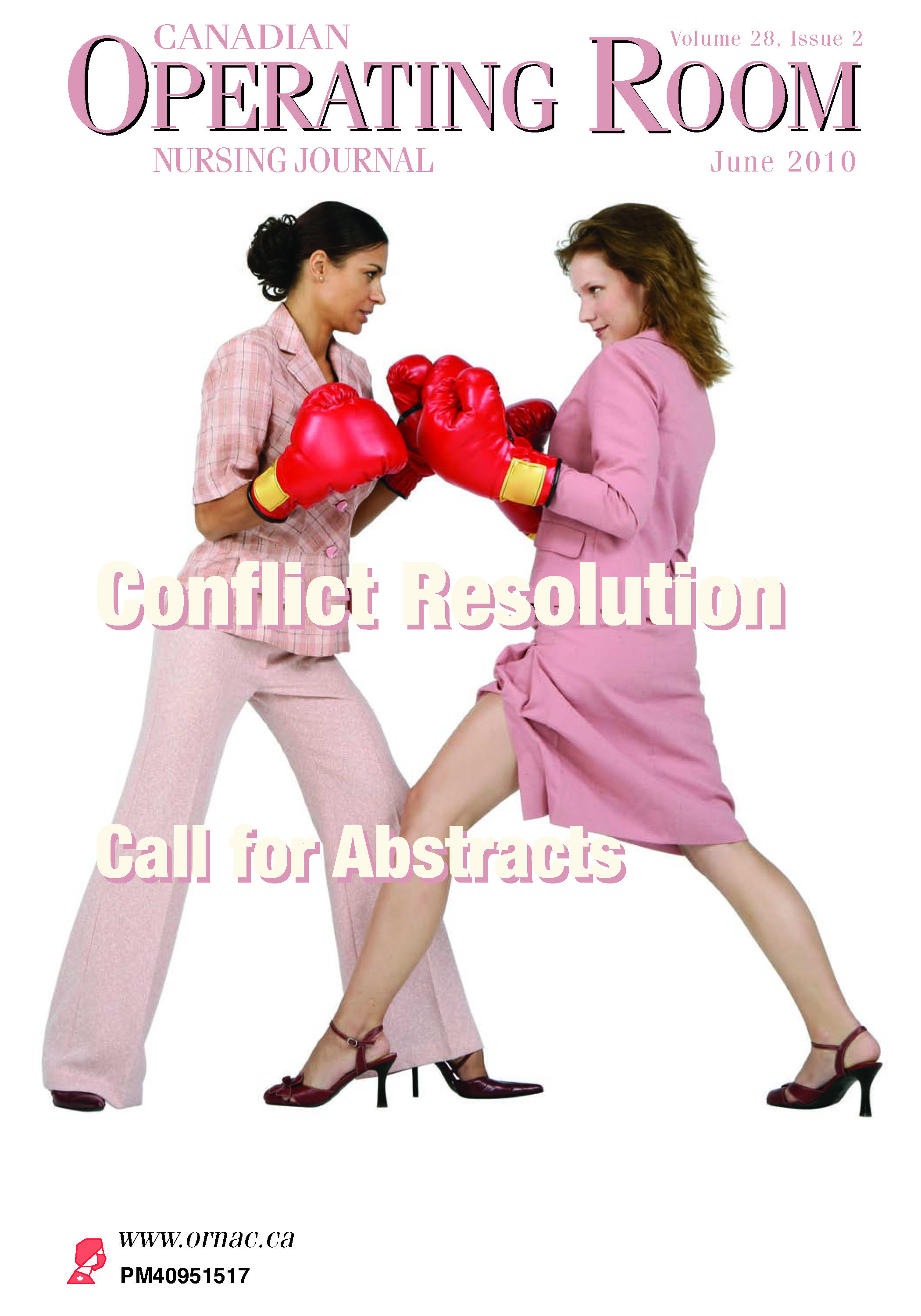
CONFLITS DANS LA SALLE D’OPÉRATION : LUTTE ET FUITE OU CROISSANCE ET COMMUNICATION
Résumé
Le conflit n’est le domaine de personne en particulier. Il prend sa source chez un individu et se propage chez les autres par effet domino. Les conflits parmi le personnel infirmier autorisé et les techniciens en salle d’opération, et entre les infirmières et les infirmières, est courant dans les salles d’opération. Le milieu opératoire se compose de plusieurs personnalités, chacune préconisant des méthodes différentes pour offrir des soins aux patients. La communication efficace est essentielle pour prévenir et résoudre les situations de conflit.
Références
Cox, K.B. “The effects of unit morale and
interpersonal relations on conflict in the
nursing unit”. Journal of Advanced Nursing.
1(2001). 17-25.
Kelly, J. “An overview of conflict”
Dimensions of Critical Care Nursing.
7(2006) : 22-28.
Grossman, S. C. and Valiga, T.M., The new
leadership challenge: Creating the future of
nursing (2nd ed.). (Philadelphia: F.A. Davis
Company 2005) 138.
Parse, R. R. “Part one: Rosemarie Rizzo
Parse’s human becoming school of thought”
Nursing Theories and Nursing Practice (2nd ed).
(Philadelphia: F.A. Davis Company 2006) 190.
Miller et al “Student and field instructor
perceptions of the learning process” Journal
of Social Work Education. 41.1(2005): 131 145.
Lancaster, L. and Stillman, D. “Understanding
generational differences makes the
workplace a better place” Bridging the
generation gap(s)”. Magazine of Physical
Therapy. 12.9. (2004): 72.
Stillman, D. “The generation gap at work”
Worklife Report. 14.4 (2003): 250.
Williams, D.M “Navigating the generation
gap: Understanding how each generation is
formed will help you better manage the
folks in the workplace” EMS Magazine.
8 (2008) : 100-104.
Notarianni et al “Engaging learners across
the generations: The progressive professional
development model” Journal of Continuing
Education in Nursing. 40.60(2009): 261-266.
Pelusi, N. “The right way to rock the boat”
Psychology Today. 39.3 (2006): 60-61.
“Recommended standards, guidelines, and
position statements for perioperative registered
nursing practice” (5th ed). (Operating
Room Nurses Association of Canada: 2003).
Kostovich et al “Learning style preference and
student aptitude for concept maps” Journal
of Nursing Education. 46.5(2007): 225-231.
Hearnden, M “Coping with differences in
culture and communication in health care”
Nursing Standard. 23.11(2008): 49-57.
Martin, C.A. “Bridging the generation
gap(s)” Nursing. 34.12 (2004): 62-63.