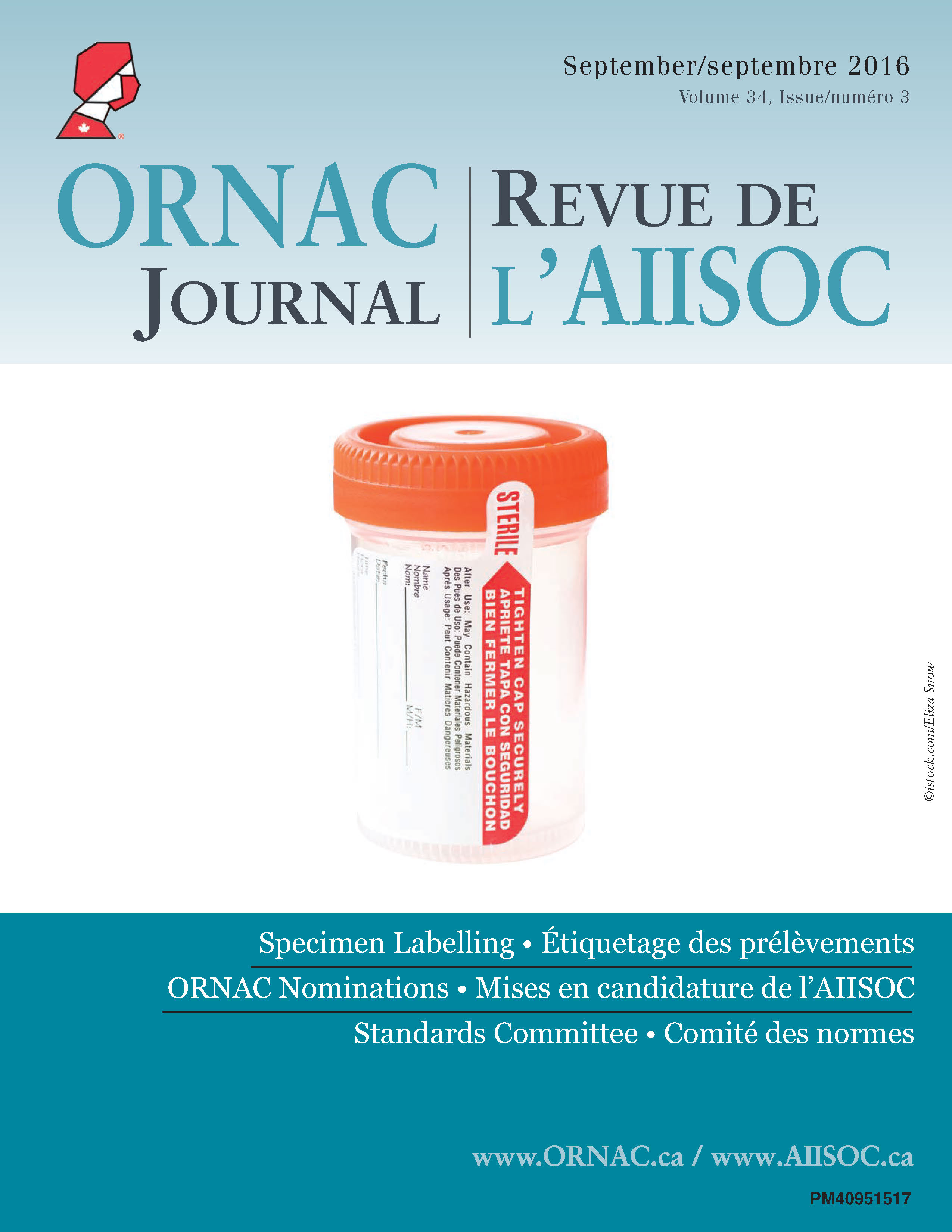
Les erreurs d’étiquetage des prélèvements sont tout simplement inacceptables en salle d’opération
Mots-clés :
recherche-action, groupes de discussion, prélèvement tissulaire, salles d’opération, soins périopératoiresRésumé
La recherche-action et les groupes de discussion sont utilisés pour aborder un problème qui a été identifié lors de la collecte de prélèvements en salle d’opération dans un bureau de santé du district de la Nouvelle-Zélande.
Références
Anonymous (2008) Taking steps to
protect patients from specimen-handling
errors. OR Manager, 24(12), 1.
Auckland District Health Board (2014).
Data collected from the risk monitor pro
system and patient information
management system. Auckland District
Health Board, Auckland.
Bhat, V., Tlwari, M., Chavan, P., &
Kelkar, R. (2013). Analysis of laboratory
sample rejections in the pre-analytical
stage at an oncology centre. Clinica
Chimica Acta, 473,1203-1206.
doi:10.1016/j.cca.2012.03.024
Collins, S. J, Newhouse, R., Porter, J,
&Talsma, A. (2014). Effectiveness of the
Surgical Safety Checklist in Correcting
Errors: A Literature Review Applying
Reason's Swiss Cheese Model. AORN
Journal, 700(1), 65-79. doi:
1016/j.aorn.2013.07.024
Conner, R, Burlingame, B, Denholm, B,
Link, T, Ogg, M., Spruce, L, Spry, C.,
Van Wicklin, S„ & Wood, A. (2014).
Perioperative Standards and
Recommended Practices: Recommended
Practices for the Care and Handling of
Specimens in the Perioperative
Environment. Retrieved from doi:
6015/psrp. 14.01.0375.
Curtis, E., & Redmond, R. (2007).
Focus groups in nursing research. Nurse
Researcher, 74(2), 25-37.
Hicks, D. G. (2014). Standardization of
Tissue Handling from the OR to the
Laboratory. AORN Journal, 99(6), 810-
doi: 10.1016/j.aorn .2014.03.005
Holter, I. M, & Schwartz-Barcott, D.
(1993). Action research: what is it? How
has it been used and how can it be used
in nursing? Journal of Advanced
Nursing, 18(2), 298-304. doi:
1046/J.1365-2648.1993.18020298.
Kim, J. K., Dotson, B., Thomas, S, &
Nelson, K. C. (2013). Standardized patient
identification and specimen labeling: A
retrospective analysis on improving patient
safety. Journal of the American Academy
of Dermatology, 68(1), 53-56.
Kohn, L. T, Corrigan, J. M., &
Donaldson, M. S. (2000). To Err Is
Human: Building a Safer Health System
(Vol. 627): National Academies Press.
Layfield, L. J, & Anderson, G, M.
(2010). Specimen Labeling Errors in
Surgical Pathology an 18-Month
Experience. American journal of clinical
pathology, 134(3), 466-470.
Makary, M. A., Epstein, J., Pronovost, P.
J., Millman, E. A., Hartmann, E. C., &
Freischlag, J. A. (2007). Surgical
specimen identification errors: A new
measure of quality in surgical care.
Surgery, 141(4), 450-455.
McNiff, J. (2013). Action research:
Principles and practice: Routledge.
Morrison, A. R, Tanasijevic, M. J.,
Goonan, E. M., Lobo, M. M., Bates, M.
M., Lipsitz, S. R. … Melanson, S. E. F.
(2010). Reduction in specimen labeling
errors after implementation of a positive
patient identification system in
phlebotomy. American journal of clinical
pathology, 733(6), 870-877.
Nakhleh, R. E. (2008). Patient safety
and error reduction in surgical
pathology. Archives of pathology &
laboratory medicine, 132(2), 181-185.
National Panel to Review Breast Biopsy
Errors. 2012. Report of the National
Panel to Review Breast Biopsy Errors:
Findings and recommendations.
Wellington: Ministry of Health.
Retrieved from website:
http://www.health.govt.nz/system/files/d
ocuments/publications/breast-biopsyerrors-
report-v3.pdf
Pennsylvania Patient Safety Authority.
(2005). Lost Surgical Specimen, Lost
Opportunites. Pennsylvania Patient
Safety Advisory, 2(3), 1-5. Retrieved
from website: http://www.patient
safetyauthority.org
Plebani, M. (2012). Quality indicators to
detect pre-analytical errors in laboratory
testing. The Clinical Biochemist
Reviews, 33(3), 85.
Reason, J. (2000). Human error: models
and management. Bmj, 320,7237), 768-
Sehgal, N., Booth, J, & Cameron, J.
(2012). Problem with the Parts was Part
of Our Problem: A Specimen Safety
Initiative. Clinical Leadership &
Management Review, 26(3), 22-27.
Slavin, L., Best, M. A., & Aron, D. C.
(2001). Gone but not forgotten: the
search for the lost surgical specimens:
application of quality improvement
techniques in reducing medical error.
Quality Management in Healthcare,
(1), 45-53.
World Health Organisation. (2009).
WHO guidelines for safe surgery:
: safe surgery saves lives. The
team will secure and accurately
identify all surgical specimens (pp. 76-
. Geneva, Switzerland: WHO
Press.
Zarbo, R. J., & D'Angelo, R. (2007).
The Henry Ford Production System
Effective Reduction of Process Defects
and Waste in Surgical Pathology.
American journal of clinical pathology,
(6), 1015-1022.