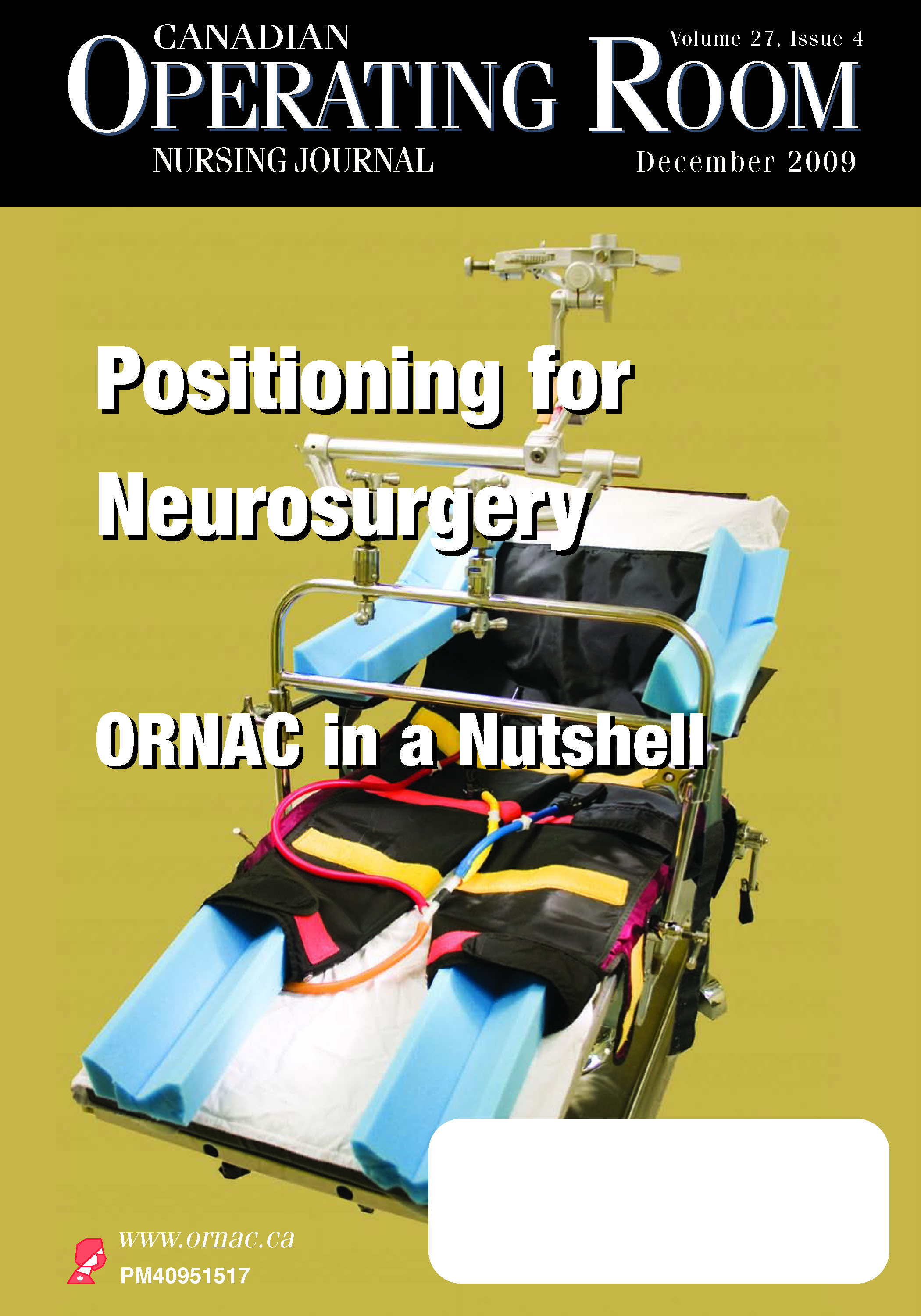
SAFE POSITIONING FOR NEUROSURGICAL PATIENTS
Abstract
Positioning the patient for surgery is an important part of perioperative nursing care that should not be underemphasized. The combined factors of time, mechanical pressure, and immobility increase the risk of tissue damage.
The objectives of perioperative positioning activities are to balance optimal surgical exposure with the prevention of any injury related to position and to maintain normal body alignment without excess flexion, extension, or rotation.
After providing general principles of positioning, specific considerations with surgical rationale are presented for each of the commonly used neurosurgical positions (eg. supine, knee-chest, prone, lateral, park-bench, sitting).
References
Goodman T. Pressure damage in surgery. July 14,
http://nursing.advanceweb. com/common/
Editorial/Search/AViewer.aspx? AN=NW_ 05jul14_
n2p33.html&AD=07-04-2005. Accessed April
, 2008.
Rithalia S, Kenney L. The art and science of
evaluating patient support surfaces. World Wide
Wounds. http://worldwidewounds.com/2001/
september/Rithalia-and-Kenney/Evaluating-
Support-Surfaces.html. Accessed April 14, 2008.
Periop 101: A Core Curriculum. Denver, CO;
AORN, Inc; 2007.
Recommended practices for positioning the
patient in the perioperative practice setting. In:
Perioperative Standards, and Recommended
Practices. Denver, CO: AORN, Inc; 2008: 497-520.
AORN guidelines for prevention of venous
stasis. AORN J. 2007;85(3):607-624.
O’Connell P. Positioning impact on the surgical
patient. Nurs Clin North Am. 2006;41(3):173-192.
Heizenroth PA. Positioning the patient for
surgery. In: Rothrock JC, Mc Ewen DR, eds.
Alexander’s Care of the Patient in Surgery. 13th
ed. St Louis, MO: Mosby; 2007:130-157.
Ferrara DL. Neurosurgery. In: Rothrock JC,
McEwen DR, eds. Alexander’s Care of the Patient
in Surgery. 13th ed. St Louis, MO: Mosby; 2007:
-862.
Winfree CJ, Kline DG. Intraoperative positioning
nerve injuries. Surg Neurol. 2005;63:5-18.
Schonauer C, Bochetti A, Maraci A,
Barbagallo G, Albanese V. Positioning on surgery
table. In: Haemostasis in Spine Surgery.
Heidelberg, Germany: Springer Berlin; 2005:50-
http://www.springerlink.com/content/j68237
u754074j3/?p=ibd64. Accessed April 23, 2008.
Graftieaux JP, Littré F, Gomis P, Malinovsky
JM. Interest and feasibility of a modified supine
position for posterior cranial fossa surgical
procedures [in French]. Ann Fr Anesth Reanim.
;23(7):751-754.
Kamming D, Clarke S. Postoperative visual
loss following prone spinal surgery. Br J Anaesth.
; 95(2):257-260.
Roth S, Tung A, Ksiazek S. Visual loss in a
prone-positioned spine surgery patient with the
head on a foam headrest and goggles covering the
eyes: an old complication with a new mechanism.
Anesth Analg. 2007;104(5):1185-1187.
Woodruff C, Hemmerling T, English M.
Postoperative visual loss after plastic surgery in
the prone position: a case report. Can J Anesth.
; 54:1230-1400.
Daley MD. Positioning and the geriatric surgical
patient. Today’s Surg Nurse. 1997;19(5):13-18.
Bambakidis NC, Gonzalez LF, Amin-
Hanjani S, et al. Combined skull base
approaches to the posterior fossa. Neurosurg
Focus. 2005;19(2):1-9. http://www.aams.org
/education/journal/neurosurgical/aug05/19-2-
pdf. Accessed April 14, 2008.
Kim LJ, Klopfenstein JD, Feiz-Erfan I,
Zubay GP, Spetzler RF. Postoperative acute
sialadenitis after skull base surgery. Skull Base.
;18:129-134. http://www .thieme-connect.
com/ejournals/abstract/sbs/doi/ 10.1055/s-
-991110. Accessed February 20, 2008.
Guarnieri J, Derlon JM, Houtteville JP. The
ventrolateral position [in French]. Neurochirurgie.
; 50(2-3 Pt 1):105-110.
Engelhardt M, Folkers W, Brenke C, et al.
Neurosurgical operations with the patient in
sitting position: analysis of risk factors using
transcranial Doppler sonography. Br J Anaesth.
;96(4):467-472.
Gale T, Leslie K. Anaesthesia for
neurosurgery in the sitting position. J Clin
Neurosci. 2004;11(7):693-696.
Butler VM, Dean LS, Little JR. Positioning
the neurosurgical patient in the operating
room: “a team effort.” J Neurosurg Nurs.
;16(2):89-95.