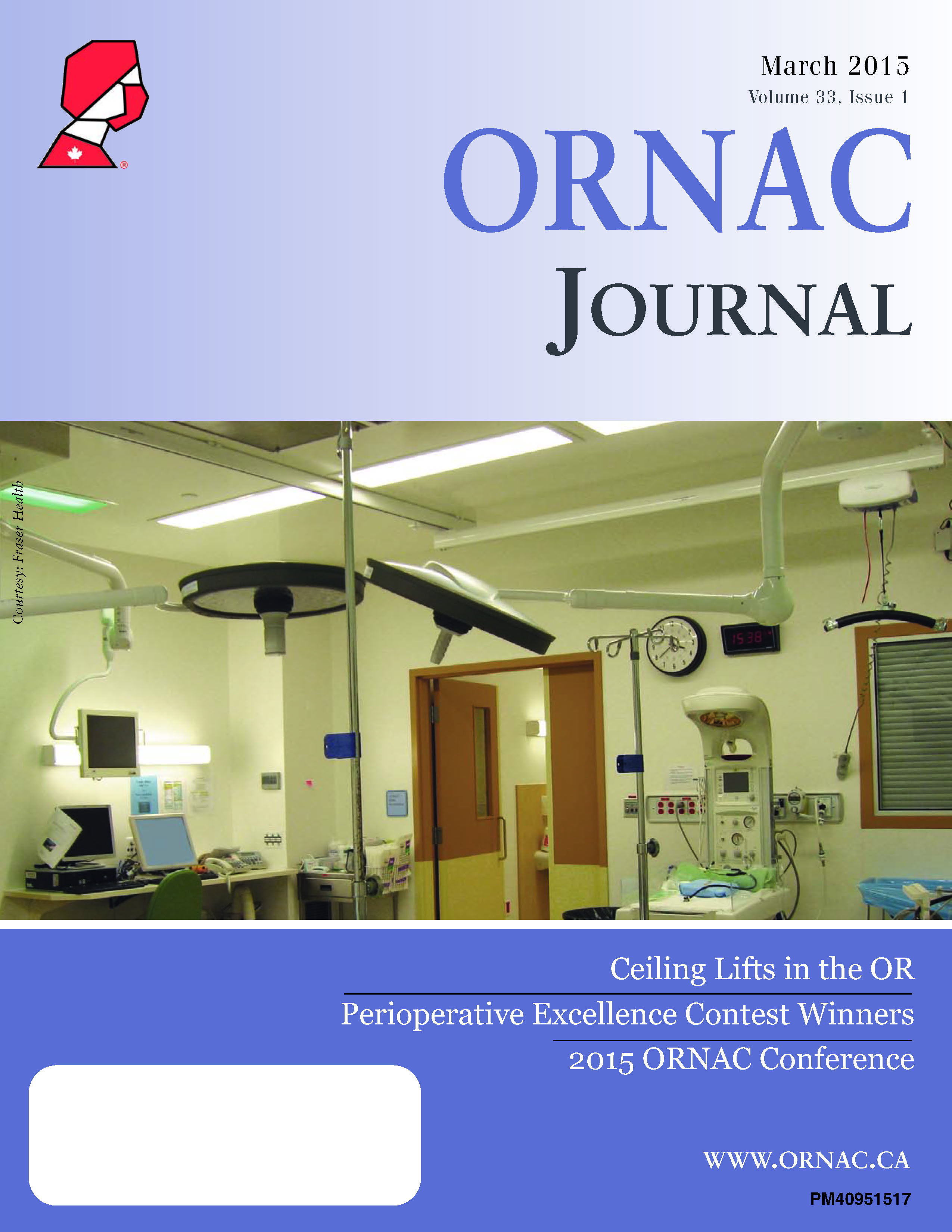
ÉVALUATION DE L’UTILISATION DE LÈVE-PERSONNES FIXÉS AU PLAFOND EN SALLE D’OPÉRATION
Mots-clés :
PERIOPERATIVE ENVIRONMENT, CEILING LIFTS, ERGONOMICS, INJURY PREVENTION.Résumé
Les travailleurs en soins de santé représentent 11 % de la main-d’oeuvre de la Colombie-Britannique et, sur une base annuelle, cela représente plus de 7 500 demandes de congé, 300 000 jours de travail perdus et une dépense de plus de 50 millions de dollars en réclamations liées à la santé à la suite de blessures musculo-squelettiques survenant en milieu de travail et liées aux soins des patients, au surmenage, à des glissements, à des faux pas et à la violence.1 Un nouvel hôpital de soins de courte durée a été construit à Abbotsford, C.-B. et a ouvert ses portes en 2008. Pendant sa construction, on a abondamment parlé des lève-personnes fixés au plafond dans tout l’établissement, notamment dans les salles d’opération. En raison du manque de documentation et de recherche concernant cette importante solution d’ingénierie ergonomique dans l’environnement des salles d’opération,2un sondage à l’intention du personnel a été effectué afin de recueillir de l’information sur la familiarité, l’utilisation et la perception du personnel face aux lèvepersonnes fixés au plafond. Les conclusions se sont révélées positives et ont démontré que le personnel pensait que les lève-personnes fixés au plafond étaient une solution d’ingénierie ergonomique pratique et utile pour l’environnement des salles d’opération et que des tâches clés de manutention des patients étaient dorénavant mises en oeuvre pour l’utilisation des lève-personnes fixés au plafond.
Références
WorkSafeBC. Slips &Trips In
Health Care And Social Assistance.
Richmond, BC : WorkSafeBC;2009.
AORN. (2014). AORN guidance
statement: Safe patient handling and
movement in the perioperative
setting. In AORN Perioperative
Standards and Recommended
Practices. (2014 ed.). Denver, CO:
Author.
WorkSafeBC. 2012 Statistics.
Richmond, BC : WorkSafeBC;
Fraser Health Authority. 2013
Accessed February 4, 2013 from
www.fraserhealth.ca/about_us/
quick_facts/.
Workplace Health Indicator
Tracking and Evaluation
(WHITE™) Database. Vancouver,
BC, Canada.
Schoenfisch, AL, Myers DJ, Pompeii
LA, Lipscomb HJ. Implementation
and adoption of mechanical patient
lift equipment in the hospital
setting: the importance of
organizational and cultural factors.
Am J Ind Med. 2011; 54:946-954.
Bartlett, GE, Hak DJ, Smith WR.
Hang them high: a hands-free
technique for limb-holding during
surgical preparation. J Orthop
Trauma. 2011; 25(7):446-48.
King, CA. Health care worker safety
in surgery. AORN J. 2011;
(5):457-468.
Waters T, et al. AORN ergonomic
tool 1: lateral transfer of a patient
from a stretcher to an OR bed.
AORN J. 2011;93(3):334-39.
Waters, T et al. AORN ergonomic
tool 2: positioning and repositioning
the supine patient on the OR bed.
AORN J. 2011; 93(4):445-49.
Waters, T et al. AORN ergonomic
tool 3: lifting and holding the
patient’s legs, arms, and head while
prepping. AORN J. 2011;
(5):589-592.
Ogg, MJ. Introduction to the safe
patient handling and movement
series AORN J. 2011; 93(3):331-33.
Petterson, P. New research looks at
ergonomic stresses on operating
room staff. OR Manager 2005;
(7):5-8.
Coleman, S, Brooke, S. Manual
handling in the operating theatre.
Professional Nurse 1999;
(10):682-86.
Nelson, A, Baptiste, AS. Evidencebased
practice for safe patient
handling and movement. Orthop
Nurs. 2006; 25(6):366-379.
Owen, BD. Preventing injuries using
an ergonomic approach. AORN J.
; 72(6):1031-36.
Waters, T et al. NIOSH research
efforts to prevent musculoskeletal
disorders in the healthcare industry.
Orthop Nurs. 2006; 25(6):380-89.