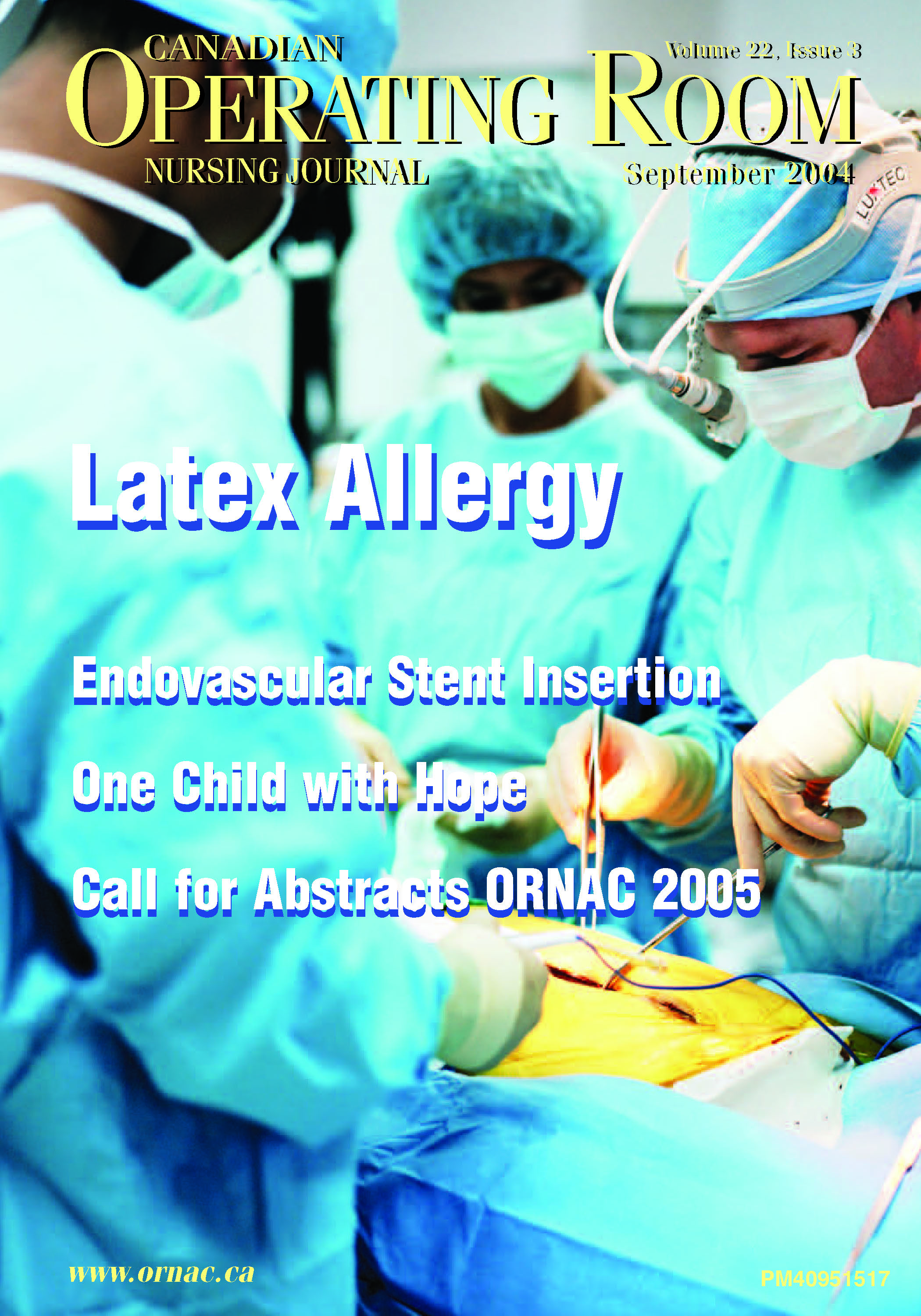
LATEX ALLERGY: STILL A CHALLENGE?
Abstract
Although latex products have been in use for over a century, allergic responses to latex proteins have only been recognized as a serious health problem for about the past 15 years.1 In 1987, when the Occupational Safety and Health Administration (OSHA) introduced Universal Precautions, the demand for examination gloves increased significantly. Since everyone who came in contact with blood or body fluids was then expected to wear hand protection, glove use increased from fewer than 1 billion pairs per year (prior to 1987) to over 20 billion pairs of gloves by 1996.2 Latex sensitization is caused by exposure to latex proteins over time, and, although stated sensitization rates vary, it has been estimated that 8 – 12% of healthcare workers are latex sensitive.
References
Meade, B. J., Weissman, D. N., & Beezhold, D. H. (2002). Latex allergy past and present. InternationalImmunopharmacology. 2, 225 – 238.
Ibid.
U.S. Department of Labor, Occupational Safety and Health Administration. (2002, November) Safety and health topics: latex allergy [Electronic version]. Retrieved November 20, 2002 from http://www.osha.gov.
Toraason, M., Sussman, G., Biagini, R., Meade, J., Beezhold, D., & Germolec, D. (2000, November). Latex allergy in the workplace [Electronic version abstract]. Toxicology Science. 58 (1), 5 – 14.
National Institute for Occupational Safety and Health. (1997). Preventing allergic reactions to natural rubber latex in the workplace.
Ibid.
Association of periOperative Registered Nurses. (2004). AORN latex guidelines. AORN Standards, Recommended Practices, and Guidelines, 103-118.
Young, M. A. (1998, March). Strategies for a latex-safe environment. Surgical Services Management. 4 (3), 19 – 24.
Association of periOperative Registered Nurses. (2004). AORN latex guidelines. AORN Standards, Recommended Practices, and Guidelines, 103-118.
Ibid.
Meade, B. J., Weissman, D. N., & Beezhold, D. H. (2002). Latex allergy past and present. International Immunopharmacology. 2, 225 – 238.
American Society of Anesthesiologists. (1999). Natural rubber latex allergy: Considerations for anesthesiologists.
Kelly, K.J. (2000), Latex allergy: where do we go from here? Canadian Journal of Allergy & Clinical Immunology. 5 (8), 337 – 340.
Ellis, H. (1990, December). The hazards of surgical glove dusting powders. Surgery, Gynecology & Obstetrics. 171, 521 – 527.
Ibid. 16. Ibid 17. Ibid.
Beezhold, D. & Beck, W.C. (1992, November). Surgical glove powders bind latex antigens. Archives of Surgery, 127, 1354 – 1357.
Swanson, M. C., & Ramalingam, M. (2002, August). Starch and natural rubber allergen interaction in the production of latex gloves: a hand- held aerosol [Electronic version abstract]. Journal of Allergy and Clinical Immunology. 110 (2 Suppl) S15- 20.
Ruhl, CM (1994), A new hazard of cornstarch, an absorbable dusting powder. Journal of Emergency Medicine. 12, 11-14.
Holmdahl, L., (1997), Mechanism of adhesion development and effects on wound healing, European Journal of Surgery 163, 7 – 9
Hunt, T. K., Slavin, J. P., & Goodson, W. H. (1994, August). Starch powder contamination of surgical wounds. Archives of Surgery. 129,
– 828.
Giercksky, K. E. (1997), Misdiagnosis of cancer due to multiple glove powder granulomas. European Journal of Surgery. 579, 11 – 14.
Chazaro, R. & Knowles, V.M. (1999, April). Innovations and change: Glove standardization. Surgical Services Management, 5, (4), 46 – 48.
Catalano, K. (1997, February). Risk management and latex allergies. Surgical Services Management, 3, (2), 42 – 46.
Kim, K. T., Graves, P. B., Safadi, G. S., Alhadeff, G. & Metcalf, J. (1998, March). Implementation recommendations for making health care facilities latex safe. AORN Journal. 67 (3), 615 – 632.
Young, M. A. (1998, March). Strategies for a latex-safe environment. Surgical Services Management. 4 (3), 19 – 24.
Ibid.
Kim, K. T., Graves, P. B., Safadi, G. S., Alhadeff, G. & Metcalf, J. (1998, March). Implementation recommendations for making health care facilities latex safe. AORN Journal. 67 (3), 615 – 632.
Ibid.
Meade, B. J., Weissman, D. N., & Beezhold, D. H. (2002). Latex allergy past and present. InternationalImmunopharmacology. 2, 225 – 238.
National Institute for Occupational Safety and Health. (1997). Preventing allergic reactions to natural rubber latex in the workplace.
American Society of Anesthesiologists. (1999). Natural rubber latex allergy: Considerations for anesthesiologists.
Ibid.