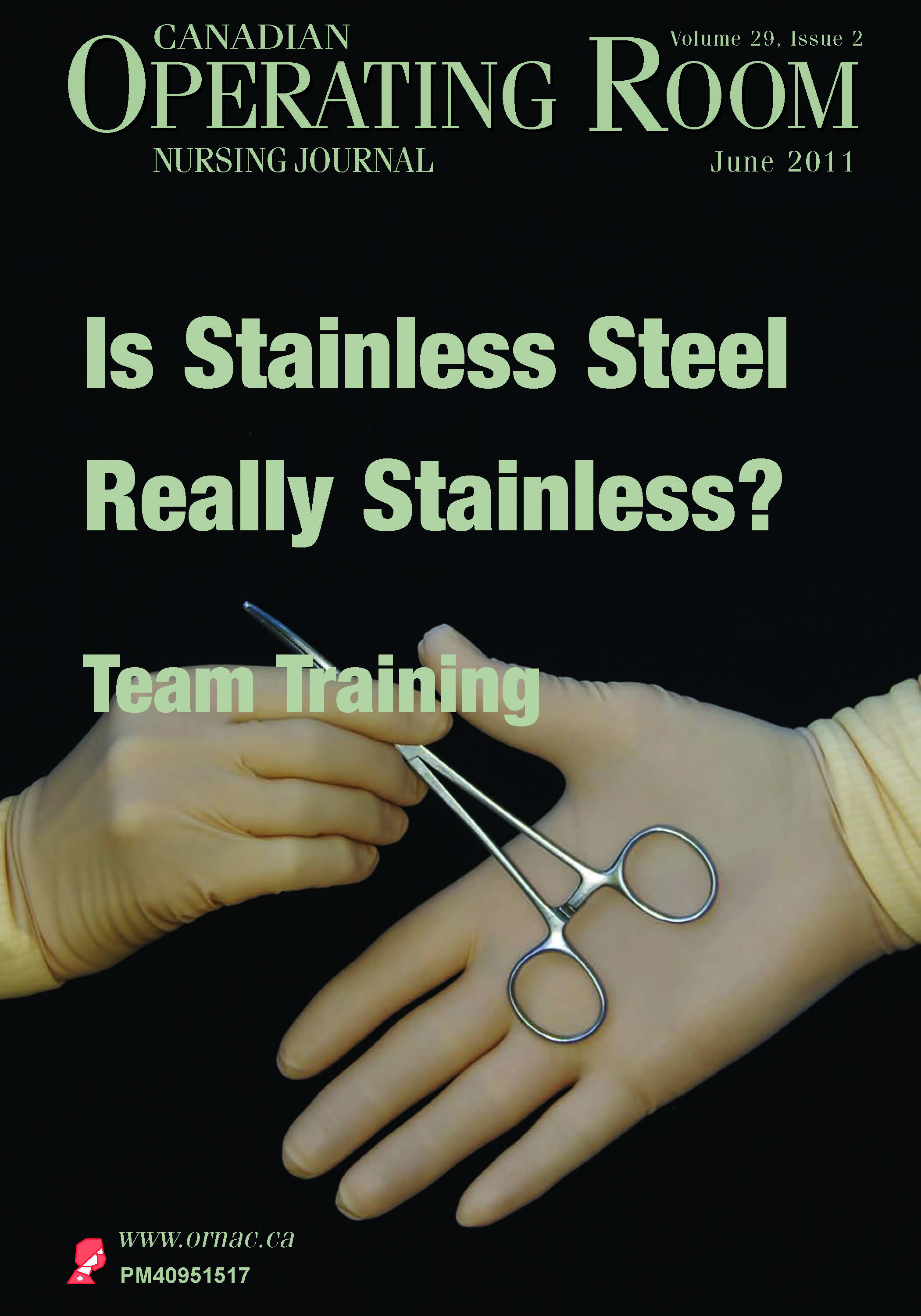
TEAM TRAINING SIMULATION IN PERIOPERATIVE NURSING EDUCATION
Abstract
The current traditional apprenticeship model in healthcare is no longer meeting the needs of our learners.1 This model requires learners to master various core skills, carry out a procedure under supervision, and relate simultaneously to other staff in the complex operating room. The approach of “see one, do one, teach one” is considered, by some, to no longer be acceptable. Perioperative nursing educators are, as a result, now faced with the challenge of finding education modalities that will facilitate the learner’s journey to competence and the delivery of safe patient care. The purpose of this paper is to discuss team training simulation in the competence development of perioperative nursing learners at the Registered Nurses Professional Development Centre (RNPDC) in Halifax, Nova Scotia.
References
Gettman, M.T. et al. (2009). Use of high
fidelity operating room simulation to assess
and teach communication, teamwork and
laparoscopic skills: Initial experience. The
Journal of Urology, 181, 1289-1296.
Anderson, M. & Leflore, J. (2008). Playing
it safe: Simulated team training in the OR.
AORN, 87(4), 772 - 779.
Clark, E.A.S. et al. (2010). Team
training/simulation. Clinical Obstetrics
and Gynecology, 53(1), 265-277.
Windsor, J.A. (2009). Role of simulation in
surgical education and training. ANZ J
Surg, 79, 127-132.
Smith, C.E. (2009). Developing simulation
scenarios for perioperative nursing core
competencies and patient safety.
Perioperative Nursing Clinics, 4,
-165.
Jeffries, P.R. & Rogers, K.J. (2007).
Simulations in Nursing Education. New
York: National League for Nursing.
World Health Organization. (2009). Safe
surgery saves lives. Retrieved May 11,
, from http://www.who.int/
patientsafety/safesurgery
Neil, J. A. (2009). Simulation in nursing
education. Perioperative Nursing Clinics,
, 97-112.