MAKING A DIFFERENCE: USING THE SAFE SURGERY CHECKLIST TO INITIATE CONTINUING EDUCATION FOR PERIOPERATIVE NURSES IN LOW-INCOME SETTINGS
Keywords:
SAFE SURGERY CHECKLIST, PERIOPERATIVE NURSING EDUCATION, AFRICAN PERIOPERATIVE NURSING, INTERNATIONAL NURSING, LOW ECONOMIC/LOW INCOME HOSPITAL SETTINGS.Abstract
The WHO Safe Surgery Checklist (2008) patient safety focus and communication prompts are widely accepted. In many low-income regions (as defined by the World Bank and accepted by the World Health Organization) perioperative nurses have little or no formal training; continuing and in-service education are virtually unknown; nor does an articulated “culture of safety” exist.1,2,3
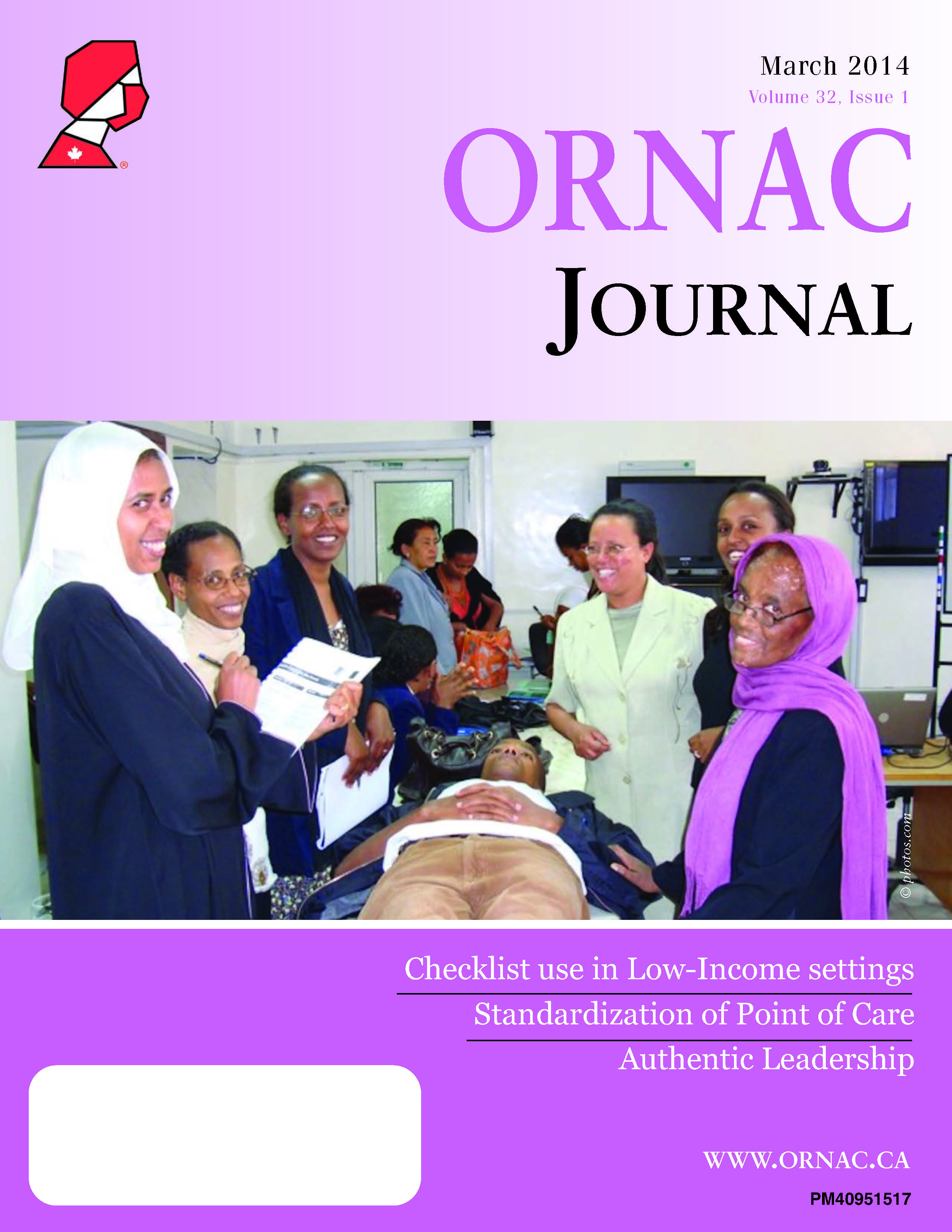
In 2009 the Canadian Network for International Surgery (CNIS) piloted a two-day perioperative nursing course, in Addis Ababa, Ethiopia, using lectures, case studies, skills sessions, and role-play exercises based on the SSSL Checklist outline and protocols. Canadian instructors (who are certified after taking the Canadian Network for International Surgery-sponsored Instructor’s Course) have since returned and taught at additional sites in Ethiopia and Uganda. Course participants now include perioperative nurses, anaesthetists, and junior surgical residents – mirroring the interdisciplinary teamwork that is crucial to safe perioperative patient care.
The course’s facilitated discussions focus on workplace and practice issues in order to allow for appropriate evaluation and planning of future educational initiatives. Participants complete pre- and post-course questionnaires, which evaluate baseline and post-course knowledge, and further follow-up is completed four months after course completion.
This article explains the need for aiding in the expansion of perioperative nursing knowledge and skill in low-income settings and provides the author’s personal perspective and experience in responding to this need. Her experience as facilitator in a pilot project and subsequent course development is described. The objective is to discuss ways that other perioperative nurses can work to make a positive difference on professional practice and patient care in low-income regions.
References
The World Bank. “How we classify countries”. (2013)
Retrieved September 20, 2013 from http://data.world
bank.org/about/country-classifications
Munjanaja, O. K., Kibuka, S., Dovlo, D. “The nursing
workforce in sub-Saharan Africa”. (2005).
International Council of Nurses. Retrieved September
, 2013 from http://www.ghdonline.org/uploads/
The_nursing_workforce_in_sub-Saharan_Africa.pdf
World Health Organization. “Evidence of unsafe care in
developing and transitional countries”. (2013) Retrieved
September 26, 2013 from http://www.who.int/
patientsafety/research/evidence_of_unsafe/en/index.html
World Health Organization. “Health Statistics and
Health Information Systems: Definition of region
groupings”. (2011). Retrieved September 8, 2013 from
http://www.who.int/healthinfo/global_burden_disease/
definition_regions/en/
Teamwork and Communication Working Group.
“Improving patient safety with effective teamwork and
communication: Literature review needs assessment,
evaluation of training tools and expert consultations”.
Canadian Patient Safety Institute; 2011.
Chris Hayes. “Surgical safety checklist: Improved
patient safety through effective teamwork”. Healthcare
Quarterly 15 (2012): 57-62.
World Health Organization. “Safe Surgery Saves Lives”.
(2009). Retrieved April 26, 2013 from http://www.who.
int/patientsafety/safesurgery/en/index.html
World Health Organization.“Surgical Safety Web Map”.
(2012) Retrieved September 20, 2013 from
http://maps.cga.harvard.edu:8080
Operating Room Nurses Association of Canada
(ORNAC). Standards, Guidelines, and Position
Statements for Perioperative Registered Nursing
Practice (11th edition). (2013). Section 1, pg(s) 28 – 31
and Section 3, p.144, Standards 3.2.6 and 3.3.1.
Walker, A., Reshamwalla, S., & Wilson, I.H. “Surgical
safety checklists: do they improve outcomes?” British
Journal of Anaesthesia. 2012; 109(1): 47-54.