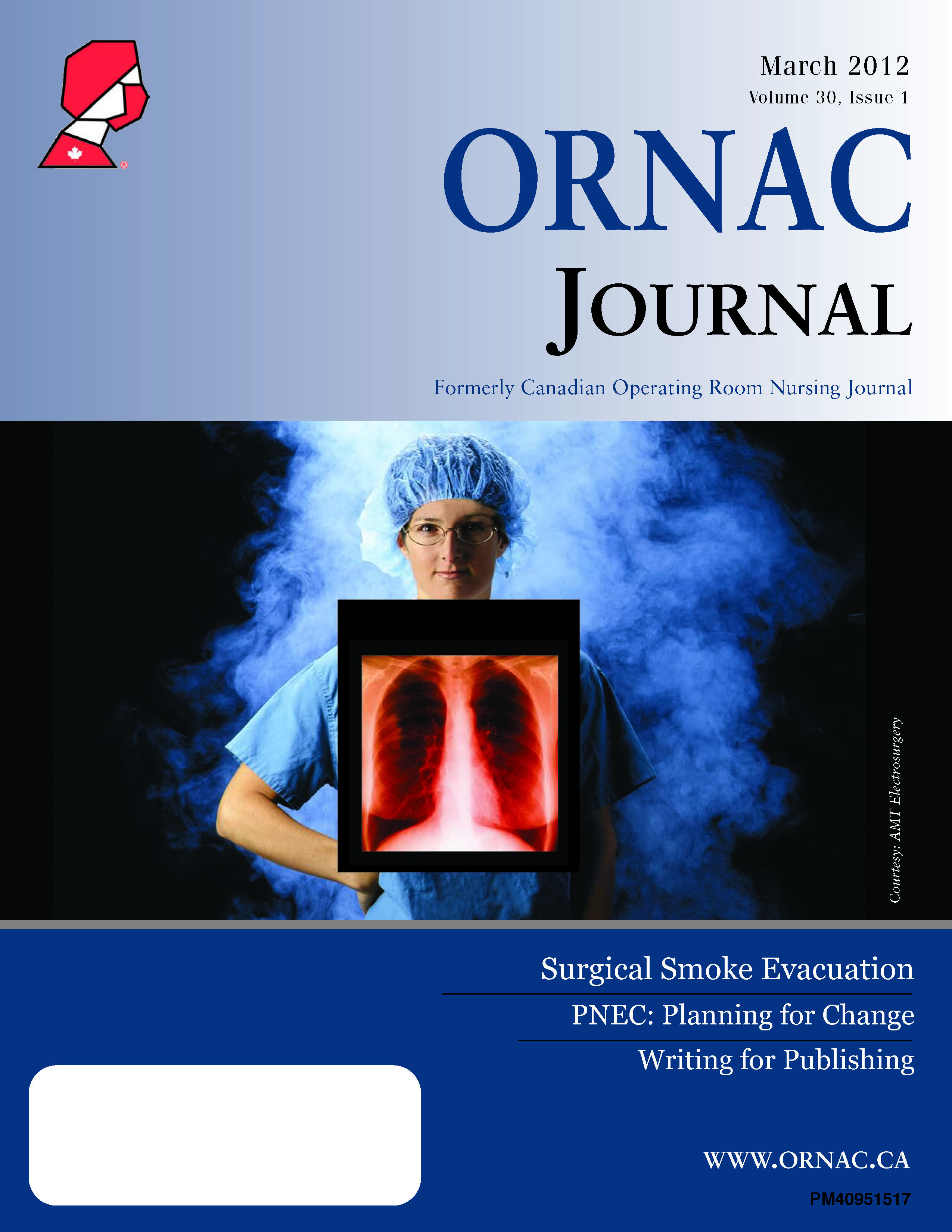
COMPLIANCE WITH SURGICAL SMOKE EVACUATION GUIDELINES: IMPLICATIONS FOR PRACTICE
Abstract
Surgical smoke presents a serious health hazard, but perioperative nurses’ compliance with smoke evacuation recommendations is not consistent. I investigated key indicators for compliance with electrosurgical smoke evacuation recommendations based on nurses’ individual innovativeness characteristics, perceptions of the attributes of smoke evacuation recommendations, and organizational innovativeness characteristics. The study findings provide implications for improving nurses’ compliance with smoke evacuation recommendations. Individual innovativeness characteristics, including nurses’ knowledge and training, were most strongly linked to smoke evacuation compliance. The key indicators that promote surgical smoke evacuation can provide direction to guide the content of education programs and help identify the personnel and settings that are most in need of this information. Barriers to compliance included lack of equipment, physician resistance, noise, and staff member complacency. Vendor demonstrations on the ease of smoke evacuation device use can show nurses that smoke evacuation is compatible with nursing practice. Facility leaders should provide smoke evacuation policies that are easy to understand and should enforce these policies.
References
Barrett W, Garber S. Surgical
smoke—a review of the literature.
Business Briefing: Global
Surgery. 2004;17(6): 1-7.
Hensman C, Baty D, Willis RG,
Cuschieri A. Chemical composition of
smoke produced by high-frequency
electrosurgery in a closed gaseous
environment: an in vitro study. Surg
Endosc. 1998;12(8):1017-1019.
Moot AR, Ledingham KM, Wilson
PF, et al. Composition of volatile
organic compounds in diathermy
plume as detected by selected ion flow
tube mass spectrometry. ANZ J Surg.
;77(1-2):20-23.
Baggish MS, Baltoyannis P, Sze E.
Protection of the rat lung from the
harmful effects of laser smoke. Lasers
Surg Med. 1988;8(3):248-253.
Edwards BE, Reiman RE. Results of
survey on current surgical smoke
control practices. AORN J. 2008:87
(4): 739-749.
Ball K. Toward a smoke-free OR.
October 2008. Outpatient Surgery.
http://www.outpatientsurgery.net/
employee_safety/2008/print&id=7311.
Accessed May 3, 2010.
Rogers EM. Diffusion of
Innovations. 5th ed. New York, NY:
Free Press; 2003.
Dobbins M, Ciliska D, Cockeril R,
Barnsley J, DiCenso A. A framework
for the dissemination and
utilization of research for health-care
policy and practice. The Online Journal
of Knowledge Synthesis for Nursing.
; 9(7):7. http://www3.interscience.
wiley. com/journal/121363229/
abstract. Accessed May 3, 2010.
Hebert M, Benbasat I. Adopting
information technology in hospitals:
the relationship between
attitudes/expectations and behavior.
Hosp Health Services Admin. 1994;
(3):369-384.
Hooper V. The Relationship of
Type of Healthcare Provider to Clinical
Practice Guideline Adoption
[dissertation]. Augusta, GA: Medical
College of Georgia; 2009.
SPSS—Statistical Package for the
Social Sciences, version 14.0. Chicago,
IL: SPSS; 2003.
AORN position statement on
surgical smoke and bioaerosols. In:
Perioperative Standards and
Recommended Practices. Denver, CO:
AORN, Inc, 2010; 754.
Resources/AORNPosition Statements/
SurgicalSmokeAndBioAerosols/.
Accessed April 27, 2010.
Recommended practices for
electrosurgery. In: Perioperative
Standards and Recommended
Practices. Denver, CO: AORN, Inc;
:105-125.
Recommended practices for laser
safety in the practice setting. In:
Perioperative Standards and
Recommended Practices. Denver, CO:
AORN, Inc; 2010:133-138.
Recommended practices for safe
environment of care. In: Perioperative
Standards and Recommended Practices.
Denver, CO: AORN, Inc; 2010:217 240.
Recommended practices for
minimally invasive surgery. In:
Perioperative Standards and
Recommended Practices. Denver, CO:
AORN, Inc; 2010:139-174.
Andersen E. Surgical smoke—is
there a fire? AAOHN J. 2005;
(3):103-104.